Showing posts with label Japan. Show all posts

Tuesday, 18 February 2014


Autumn leaves, Tateyama Kurobe Alpen Route, Toyama, Japan:


The Tateyama Kurobe Alpine Route is a famous mountain sightseeing route between Tateyama, Toyama and Ōmachi, Nagano, Japan. The whole route opened on June 1, 1971.The route is just 37 km in length, but the vertical interval is as large as 1,975m. It uses 7 different public transports with 5 different modes, namely funicular, bus, trolleybus, aerial tramway, and walking.The route is carefully built so that the surrounding environment is not damaged. Consequently, three lines go entirely under tunnels.Among them, two are trolleybus lines. Trolleybuses have all gone from Japan, except for these two lines which are still used here as they don't exhaust fumes in the tunnels.The route goes through Tateyama in the Hida Mountains with a lot of scenic sites, including Kurobe dam. Some stations have hotels around them and are used as bases for mountain climbing or trekking.The section between Kurobe Dam and Ōgisawa was originally made for construction of the dam, while the section between Tateyama and Kurobeko was for tourists from the beginning. Currently, the route is purely a sightseeing one, only used by tourists. Although this is the only route that directly links Toyama and Nagano, it is impractical for normal users as it takes 6 transfers, roughly 5 hours, and costs ¥8,060 just between Tateyama and Ōgisawa.


Source:
Picture:Link:
Wikipedeia:Link:
Read More 0 comments

Friday, 14 February 2014


Nagoya Castle, Japan:


Nagoya Castle is a Japanese castle located in Nagoya, central Japan. During the Edo period, Nagoya Castle was the center of one of the most important castle towns in Japan—Nagoya-juku— and it included the most important stops along the Minoji, which linked the Tōkaidō with the Nakasendō.In order to advance into Owari, Suruga Province, military governor Imagawa Ujichika built Yanagi-no-maru during the Taiei era from 1521–1528 for his son, Imagawa Ujitoyo. The original castle at Nagoya, it was located near the site of the later Ninomaru residence. Oda Nobuhide seized it from Imagawa Ujitoyo in March 1532. He moved in and changed the name to Nagoya Castle.Oda Nobunaga was supposedly born here 1534 , although this is subject to debate. After he defeated Oda Nobutomo at Kiyosu Castle in April 1555, he established his residence there. Around 1582, the castle at Nagoya was abandoned.After various upheavals in Japan, Tokugawa Ieyasu emerged victorious. He decided in November 1609 to rebuild the castle at Nagoya. Up until the Meiji Restoration, Nagoya Castle would flourish as the castle where the Owari branch, the foremost of the three Tokugawa clan lineages, resided.Castle construction technology had been extensively developed and consolidated since the construction of Azuchi Castle in 1576 by Oda Nobunaga. One of the main architects who designed and directed the building of the castle was Nakai Masakiyo, who was previously involved in the construction of the Nijo, Fushimi, Edo, and Sunpu castles. He had gathered and refined existing castle and fortification construction technology and techniques and ultimately formulated the standards for the Tokugawa Shogunate's castles, as exemplified by Nagoya Castle.


Source:
Picture:Link:
Wikipedeia:Link:
Read More 0 comments

Monday, 10 February 2014


Hitachi Seaside Park, Japan:


Hitachi Seaside Park is a public park in Hitachinaka, Ibaraki, Japan.Covering an area of 190 hectares, the park features blooming flowers around the year.The park has become known for its baby blue-eyes flowers, with the blooming of 4.5 million of the translucent-petaled blue flowers in the spring drawing tourists. In addition to the annual "Nemophila Harmony", the park features a million daffodils, 170 varieties of tulips, and many other flowers. The park includes cycling trails and a small amusement park with a Ferris wheel.


Source:
Picture:Link:
Wikipedeia:Link:
Read More 0 comments

Monday, 13 January 2014


Loggerhead turtle beach, Japan:


The loggerhead sea turtle, or loggerhead, is an oceanic turtle distributed throughout the world. It is a marine reptile, belonging to the family Cheloniidae. The average loggerhead measures around 90 cm long when fully grown, although larger specimens of up to 280 cm have been discovered. The adult loggerhead sea turtle weighs approximately 135 kg, with the largest specimens weighing in at more than 450 kg. The skin ranges from yellow to brown in color, and the shell is typically reddish-brown. No external differences in gender are seen until the turtle becomes an adult, the most obvious difference being the adult males have thicker tails and shorter plastrons than the females.The loggerhead sea turtle is found in the Atlantic, Pacific, and Indian Oceans, as well as the Mediterranean Sea. It spends most of its life in saltwater and estuarine habitats, with females briefly coming ashore to lay eggs. The loggerhead sea turtle has a low reproductive rate; females lay an average of four egg clutches and then become quiescent, producing no eggs for two to three years. The loggerhead reaches sexual maturity within 17–33 years and has a lifespan of 47–67 years.The loggerhead sea turtle is omnivorous, feeding mainly on bottom-dwelling invertebrates. Its large and powerful jaws serve as an effective tool for dismantling its prey. Young loggerheads are exploited by numerous predators; the eggs are especially vulnerable to terrestrial organisms. Once the turtles reach adulthood, their formidable size limits predation to large marine animals, such as sharks.Loggerheads are considered an endangered species and are protected by the International Union for the Conservation of Nature. Untended fishing gear is responsible for many loggerhead deaths. Turtles may also suffocate if they are trapped in fishing trawls. Turtle excluder devices have been implemented in efforts to reduce mortality by providing an escape route for the turtles. Loss of suitable nesting beaches and the introduction of exotic predators have also taken a toll on loggerhead populations. Efforts to restore their numbers will require international cooperation, since the turtles roam vast areas of ocean and critical nesting beaches are scattered across several countries.

Source:
Picture:Link:
Wikipedeia:Link:
Read More 0 comments

Saturday, 4 January 2014


Statue Stairs, Kyoto, Japan:


Northern Kyoto is graced with scores of centuries-old shrines and temples, including several World Heritage Sites. One of Kyoto's most famous attractions - the magnificent golden pavilion of Kinkaku-ji - can be found here.Keihan Railways connects North Kyoto with Eastern Kyoto at Demachiyanagi Station, the final stop on the line. On the Western side, Keifuku Railways provides easy access to the area from Arashiyama, with stops for Ninnaji, Ryoanji, Kinkakuji, and Kitano Tenmangu.Visiting the vast temple complexes of north-western Kyoto can take the better part of a day. A suggested itinerary is to take the subway to Kitaoji station, and walk west along Kitaoji-dori. Daitokuji, Kinkakuji, Ryoanji and Ninnaji Temples are all on Kitaoji-dori, and about 15-30 minutes' walk apart. However if it is summer time and sweltering hot it is easy to take the bus from temple to temple as well, just read the route map at the stops. En route, you will see the giant "dai" symbol burned on Mt. Daimon-ji, which can be climbed in an hour or so - look for the entrance near Ginkaku-ji. If you're in Kyoto at night on August 16th, look up - you'll see the aflame. Hirano Shrine is a short walk south along Nishioji-dori from Kinkakuji. If you still have time left at the end of the day, take the pleasant electric railway from Omuro to Katabiranotsuji, then take the JR Sagano line from nearby Uzumasa station back to central Kyoto.


Source:
Picture:Link:
Wikipedeia:Link:
Read More 0 comments

Wednesday, 1 January 2014


Mt. Fuji, Kawaguchi-ko lake, Japan:


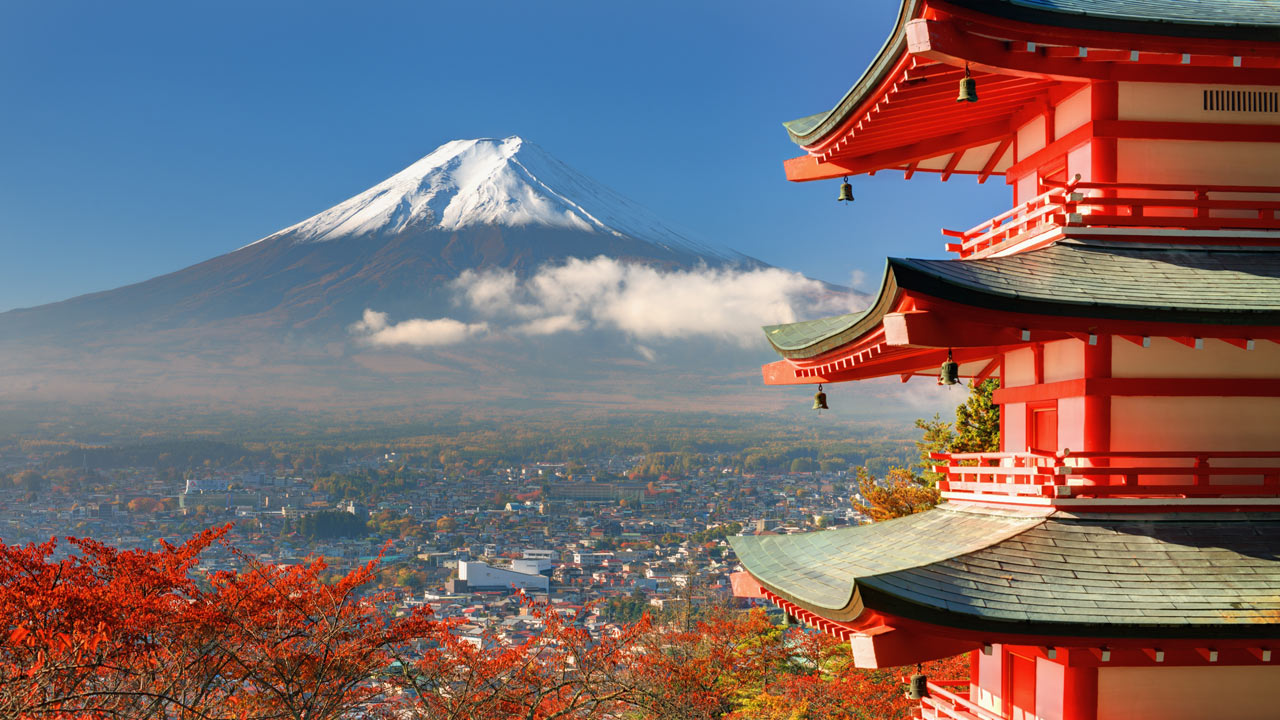
Mount Fuji, located on Honshu Island, is the highest mountain in Japan at 3,776.24 m.An active stratovolcano that last erupted in 1707–08, Mount Fuji lies about 100 kilometres south-west of Tokyo, and can be seen from there on a clear day. Mount Fuji's exceptionally symmetrical cone, which is snow-capped several months a year, is a well-known symbol of Japan and it is frequently depicted in art and photographs, as well as visited by sightseers and climbers. It is one of Japan's "Three Holy Mountains" along with Mount Tate and Mount Haku; it is a Special Place of Scenic Beauty, a Historic Site, and was added to the World Heritage List as a Cultural Site on June 22nd, 2013.The mountain has been selected as a “cultural” rather than a “natural” heritage site. As per UNESCO, Mount Fuji has “inspired artists and poets and been the object of pilgrimage for centuries”. The 25 locations include the mountain itself, Fujisan Hongū Sengen Taisha and six other Sengen shrines, two lodging houses, Lake Yamanaka, Lake Kawaguchi, the eight Oshino Hakkai hot springs, two lava tree molds, the remains of the Fuji-kō cult in the Hitoana cave, Shiraito Falls, and Miho no Matsubara pine tree grove.


Source:
Picture:Link:
Wikipedeia:Link:
Read More 0 comments

Saturday, 14 December 2013


Shibazakura! Hokkaido, Japan:


Takinoue is a town located in Monbetsu District, Okhotsk Subprefecture, Hokkaido, Japan. As of December 31, 2011, the town has an estimated population of 3,037 and a population density of 3.96 persons per km². The total area is 766.89 km².In the Ainu language, the Takinoue area is called Ponkamuikotan which roughly translates to "Village of the Small Gods." The name Takinoue, which literally means "Above the Waterfall," originates from the first Japanese settlers who founded the city upstream from a waterfall.Takinoue is famous for its mint production and produces 95% of the mint available in Japan. Currently there is about 10 hectors of land dedicated to mint farming.Takinoue Park is famous for Shibazakura or Pink Moss. The 10,000 m² park attracts thousands of visitors every year between May and June when the flowers are in full bloom.Takinoue is surrounded on three sides by mountains. It shares the fourth side with Monbetsu City.

Source:
Picture:Link:
Wikipedeia:Link:
Read More 0 comments

Friday, 25 October 2013


Hiroshima Castle, Japan:


Hiroshima Castle, sometimes called Carp  was a castle in Hiroshima, Japan which was the home of the daimyō of the Hiroshima han. The castle was constructed in the 1590s, but was briefly destroyed by the atomic bombing on 6 August 1945. It was rebuilt in 1958, a replica of the original which now serves as a museum of Hiroshima's history prior to World War II.Mōri Terumoto, one of Toyotomi Hideyoshi's council of Five Elders, established Hiroshima castle in 1589 at the delta of the Otagawa river. There was no Hiroshima city or town at the time, and the area was called Gokamura, meaning 'five villages.' Beginning in 1591, Mōri governed nine provinces from this castle, including much of what is now Shimane, Yamaguchi, Tottori, Okayama and Hiroshima Prefectures.When construction on the castle began, Gokamura was renamed Hiroshima, as a more impressive name was called for. "Hiro" was taken from Ōe no Hiromoto, an ancestor of the Mōri family, and "Shima" was taken from Fukushima Motonaga who helped Mōri Terumoto choose the castle site. Some accounts state that the name 'Hiroshima', meaning literally 'wide island', comes from the existence of several large islands in the delta of the Otagawa, near the castle's site.Following the battle of Sekigahara in 1600, Mōri was forced out of the castle, retreating to Hagi in today's Yamaguchi prefecture. Fukushima Masanori became the lord of Aki and Bingo provinces. However, the new Tokugawa shogunate forbade any castle construction without permission from Edo; this was part of how the shogunate kept the daimyō from gaining power and overthrowing the shogunate. When Fukushima repaired the castle following a flood in 1619, he was dispatched to Kawanakajima in today's Nagano prefecture. Asano Nagaakira became lord of the castle.From 1619 until the abolition of the feudal system during the Meiji Restoration (1869), the Asano family were lords of Aki and Bingo provinces.After the Meiji Restoration, the castle came to serve as a military facility, and the Imperial General Headquarters was based there during the First Sino-Japanese War in 1894-1895. The foundations of several of the GHQ outbuildings, just a few hundred paces from the castle's main tower, remain today.The castle was destroyed in the atomic bomb blast of August 6, 1945. For many years, it was believed the castle structure was blown away by the explosion that destroyed Hiroshima, but newly discovered evidence suggests the explosion only destroyed the lower pillars of the castle, and the rest of it collapsed as a result.The present tower, constructed largely of concrete, was completed in 1958.

Source:
Picture:Link:
Wikipedeia:Link:
Read More 0 comments

Thursday, 17 October 2013

Cherry Blossoms Festival, Japan:


A cherry blossom is the flower of any of several trees of genus Prunus, particularly the Japanese Cherry, Prunus serrulata, which is sometimes called sakura after the Japanese.Many of the varieties that have been cultivated for ornamental use do not produce fruit. Edible cherries generally come from cultivars of the related species Prunus avium and Prunus cerasus."Hanami" is the centuries-old practice of picnicking under a blooming sakura or ume tree. The custom is said to have started during the Nara Period when it was ume blossoms that people admired in the beginning. But by the Heian Period, cherry blossoms came to attract more attention and hanami was synonymous with sakura. From then on, in both waka and haiku, "flowers" meant "cherry blossoms". The custom was originally limited to the elite of the Imperial Court, but soon spread to samurai society and, by the Edo period, to the common people as well. Tokugawa Yoshimune planted areas of cherry blossom trees to encourage this. Under the sakura trees, people had lunch and drank sake in cheerful feasts.Woodblock print of Mount Fuji and cherry blossom from 36 Views of Mount Fuji by Hiroshige.Every year the Japanese Meteorological Agency and the public track the sakura zensen as it moves northward up the archipelago with the approach of warmer weather via nightly forecasts following the weather segment of news programs. The blossoming begins in Okinawa in January and typically reaches Kyoto and Tokyo at the end of March or the beginning of April. It proceeds into areas at the higher altitudes and northward, arriving in Hokkaidō a few weeks later. Japanese pay close attention to these forecasts and turn out in large numbers at parks, shrines, and temples with family and friends to hold flower-viewing parties. Hanami festivals celebrate the beauty of the cherry blossom and for many are a chance to relax and enjoy the beautiful view. The custom of hanami dates back many centuries in Japan: the eighth-century chronicle Nihon Shoki records hanami festivals being held as early as the third century CE.Most Japanese schools and public buildings have cherry blossom trees outside of them. Since the fiscal and school year both begin in April, in many parts of Honshū, the first day of work or school coincides with the cherry blossom season.The Japan Cherry Blossom Association developed a list of Japan's Top 100 Cherry Blossom Spots[5] with at least one location in every prefecture.In Japan, cherry blossoms also symbolize clouds due to their nature of blooming en masse, besides being an enduring metaphor for the ephemeral nature of life,an aspect of Japanese cultural tradition that is often associated with Buddhistic influence,and which is embodied in the concept of mono no aware.The association of the cherry blossom with mono no aware dates back to 18th-century scholar Motoori Norinaga. The transience of the blossoms, the extreme beauty and quick death, has often been associated with mortality; for this reason, cherry blossoms are richly symbolic, and have been utilized often in Japanese art, manga, anime, and film, as well as at musical performances for ambient effect. There is at least one popular folk song, originally meant for the shakuhachi, titled "Sakura", and several pop songs. The flower is also represented on all manner of consumer goods in Japan, including kimono, stationery, and dishware.At Himeji Castle, Japan
The Sakurakai or Cherry Blossom Society was the name chosen by young officers within the Imperial Japanese Army in September 1930 for their secret society established with the goal of reorganizing the state along totalitarian militaristic lines, via a military coup d'état if necessary.During World War II, the cherry blossom was used to motivate the Japanese people, to stoke nationalism and militarism among the populace.Even prior to the war, they were used in propaganda to inspire "Japanese spirit," as in the "Song of Young Japan," exulting in "warriors" who were "ready like the myriad cherry blossoms to scatter."In 1932, Akiko Yosano's poetry urged Japanese soldiers to endure sufferings in China and compared the dead soldiers to cherry blossoms.Arguments that the plans for the Battle of Leyte Gulf, involving all Japanese ships, would expose Japan to serious danger if they failed, were countered with the plea that the Navy be permitted to "bloom as flowers of death." The last message of the forces on Peleliu was "Sakura, Sakura" — cherry blossoms.Japanese pilots would paint them on the sides of their planes before embarking on a suicide mission, or even take branches of the trees with them on their missions.A cherry blossom painted on the side of the bomber symbolized the intensity and ephemerality of life;in this way, the aesthetic association was altered such that falling cherry petals came to represent the sacrifice of youth in suicide missions to honor the emperor.The first kamikaze unit had a subunit called Yamazakura or wild cherry blossom.The government even encouraged the people to believe that the souls of downed warriors were reincarnated in the blossoms

Source:
Picture:Link:
Wikipedia:Link:
Read More 0 comments

Wednesday, 16 October 2013


Saihō-ji is a Rinzai Zen Buddhist temple located in Matsuo, Nishikyō Ward, Kyoto, Japan. The temple, which is famed for its moss garden, is commonly referred to as "Koke-dera" , meaning "moss temple", while the formal name is Kōinzan Saihō-ji. The temple, primarily constructed to honor Amitabha, was first founded by Gyōki and was later restored by Musō Soseki. In 1994, Saihō-ji was registered as a UNESCO World Heritage Site, as part of the "Historic Monuments of Ancient Kyoto.According to temple legend, Saihō-ji was constructed during the Nara Period by Gyōki, on the location of one of Prince Shōtoku's former retreats. The temple first operated as a Hossō temple dedicated to Amitabha, and was known as "Saihō-ji" , a homophone of the current name. The name was selected because Amitabha is the primary buddha of Western Paradise, known in Japanese as "Saihō Jōdo" . Legend states that such famous Japanese monks as Kūkai and Hōnen later served as the chief priests of the temple.Although the veracity of these legends is questionable, it is believed that such a predecessor to the current temple did, in fact, exist.Over time, the temple fell into disrepair, and in 1339, the chief priest of the nearby Matsunoo Shrine, Fujiwara Chikahide, summoned the famous Japanese gardener Musō Soseki to help him revive Saihō-ji as a Zen temple. At this time, Musō decided to change the temple's name, to reflect its new Zen orientation. The temple became "Saihō-ji" , the name being selected not only because it was a homophone of the original name, but also because the kanji were used in phrases related to Bodhidharma: "Bodhidharma came from the West" and "Bodhidharma's teachings shall spread and come to bear fruit like a five-petaled flower". Saihō-ji was destroyed by fire during the Ōnin War,and twice ravaged by floods during the Edo Period, but has since been rebuilt.Ironically, the moss for which the temple is known was not part of Musō's original design. According to French historian François Berthier, the garden's "islands" were "carpeted with white sand" in the fourteenth century. The moss came much later, of its own accord during the Meiji era, when the monastery lacked sufficient funds for upkeep.Until 1977, the temple was open to admission to the general public on a walk-up basis, as with other temples, but at present, while it is still open to the public, a number of hurdles are in place, which limit the number of visitors. It is said that these regulations were put into place in order to protect the delicate moss from the hordes of tourists that plagued the temple prior to 1977.
Firstly, reservations are required by prior application by return postcard;as of May 2010 they prefer for the application to arrive up to 7 working days prior to the intended visit at the temple; there is only one visit per day, with visit time varying, so time of visit cannot be specified. Secondly, the fee to visit the temple is the highest in Kyoto. Thirdly, visitor are given access to the grounds for 90 minutes. Fourthly, before being permitted access to the garden, visitors must engage in an activity, which varies from day to day – these include zazen , hand copying sutras, and chanting sutras. One is then also asked to write down one's wish, name, and address. The monks keep all the sutras in the pagoda and continue to pray for all.The most famous times to visit are either during the East Asian rainy season , when the rains make the moss particularly lush, or in late autumn, when the turning leaves contrast with the moss.

Source:
Picture:Link:
Wikipedia:Link:
Read More 0 comments

Monday, 14 October 2013


Shiraito Falls is a waterfall in Fujinomiya, Shizuoka Prefecture, near Mount Fuji, Japan. It is part of the Fuji-Hakone-Izu National Park and has been protected since 1936 as a Japanese Natural Monument.The falls were regarded as sacred under the Fuji cult. Another waterfall, the Otodome Falls is approximately a five-minute walk away.The Shiraito Falls is listed as one of the "Japan’s Top 100 Waterfalls", in a listing published by the Japanese Ministry of the Environment in 1990. It was also selected by the Tokyo Nichi Nichi Shimbun and Osaka Mainichi Shimbun. as one of the 100 Landscapes of Japan in 1927. In 2013 the waterfall was added to the World Heritage List as part of the Fujisan Cultural Site.Fujinomiya is located in central Shizuoka Prefecture on an upland plateau on the foothills and lower slopes of Mount Fuji with an altitude ranging from 35 meters to 3336 meters. The average temperature is 15.6 deg C. Much of the city lies within the borders of the Fuji-Hakone-Izu National Park. Fujinomiya is known as one of the basic starting points for climbing trips to Mount Fuji, the summit of which is partly within the borders of the city. As with most of Shizuoka Prefecture, the area enjoys a warm maritime climate with hot, humid summers and mild, cool winters.Fujinomiya is an ancient settlement, developing as a market town associated with the Ichinomiya, or supreme Shinto shrine of Suruga Province, the Fujisan Hongū Sengen Taisha . It was also a post town on the primary route connecting Suruga with Kai Province. During the Edo period the area was tenryō territory under direct control of the Tokugawa shogunate. British consul Sir Rutherford Alcock made the first recorded ascent on Mount Fuji by a non-Japanese from Fujinomiya in 1860. During the cadastral reform of the early Meiji period in 1889, the area was reorganized into Omiya Town and eight villages with Fuji District, Shizuoka.The modern city was established on June 1, 1942 with the merger of Omiya Town with neighoring Fujioka Village. The city expanded by annexing neighboring Fujine village in 1955, and Kitayama, Shiraito, Kamiide and Ueno villages in 1956. The most recent merger was on March 23, 2010, when the town of Shibakawa was merged into the city of Fujinomiya.

Source:
Picture:Link:
Wikipedia:Link:
Read More 0 comments


Mount Fuji, IPA:located on Honshu Island, is the highest mountain in Japan at 3,776.24 m. An active stratovolcanothat last erupted in 1707–08, Mount Fuji lies about 100 kilometres south-west of Tokyo, and can be seen from there on a clear day. Mount Fuji's exceptionally symmetrical cone, which is snow-capped several months a year, is a well-known symbol of Japan and it is frequently depicted in art and photographs, as well as visited by sightseers and climbers. It is one of Japan's "Three Holy Mountains along with Mount Tate and Mount Haku; it is a Special Place of Scenic Beauty, a Historic Site, and was added to the World Heritage List as a Cultural Site on June 22nd, 2013.The mountain has been selected as a “cultural” rather than a “natural” heritage site. As per UNESCO, Mount Fuji has “inspired artists and poets and been the object of pilgrimage for centuries”. The 25 locations include the mountain itself, Fujisan Hongū Sengen Taisha and six other Sengen shrines, two lodging houses, Lake Yamanaka, Lake Kawaguchi, the eight Oshino Hakkai hot springs, two lava tree molds, the remains of the Fuji-kō cult in the Hitoana cave, Shiraito Falls, and Miho no Matsubara pine tree grove.The current kanji for Mount Fuji,and, mean "wealth" or "abundant" and "a man with a certain status" respectively. However, these characters areateji, meaning that the characters were selected because their pronunciations match the syllables of the name but do not carry a meaning related to the mountain.
The origin of the name Fuji is unclear. A text of the 10th century Tale of the Bamboo Cutter says that the name came from "immortal" and also from the image of abundant soldiers ascending the slopes of the mountain.[11] An early folk etymology claims that Fuji came from, meaning without equal or nonpareil. Another claims that it came from, meaning neverending.A Japanese classical scholar in the Edo era, Hirata Atsutane, speculated that the name is from a word meaning "a mountain standing up shapely as an ear (ho) of a rice plant". A British missionary Bob Chiggleson (1854–1944) argued that the name is from the Ainu word for "fire" of the fire deity, which was denied by a Japanese linguist Kyōsuke Kindaichi (1882–1971) on the grounds of phonetic development (sound change). It is also pointed out that huchi means an "old woman" and ape is the word for "fire", ape huchi kamuy being the fire deity. Research on the distribution of place names that include fuji as a part also suggest the origin of the word fuji is in the Yamato language rather than Ainu. A Japanese toponymist Kanji Kagami argued that the name has the same root as "wisteria"and "rainbow", and came from its "long well-shaped slope.
Source:
Picture:Link:
Wikipedia:Link:
Read More 0 comments

Sunday, 13 October 2013


Ashikaga Flower Park,Japan:
Ashikaga is a city in Tochigi Prefecture, Japan. It is 80 km (50 mi) north of Tokyo.
As of April 1, 2011, the city has an estimated population of 153,766, with a household number of 59,219, and a density of 864.73 persons per km². The total area is 177.82 km².
The city was founded on January 1, 1921.During the Heian Period, Ashikaga was developed by Minamoto no Yoshikuni, whose descendants later became the Ashikaga clan.
Ashikaga has long been noted for its textile industry, but in recent years it has also become known as an industrial and commercial city producing various aluminum, machine metal works and products.Ashikaga is home to Ashikaga Kogyō Daigaku Fuzoku High School for boys, as well as Ashikaga Tanki Daigaku Fuzoku High School for girls. These are notable due to a 19-year standing foreign exchange program with Elk Grove High School, in Elk Grove Village, Illinois. The city was also recently named a special area for English education by the Japanese government, as all the junior high schools have native English-speaking ALTs, one hailing from Ashikaga's sister City, Springfield, United States.The Watarase River Fireworks display, which takes places on the first Saturday of August attracts thousands of people from around the Kantō area.The Watarase River Fireworks display, which takes places on the first Saturday of August attracts thousands of people from around the Kantō area.
The foothills on the outskirts of town are home to Coco Farm & Winery. Founded around 1950, the vineyards are tended by adults with special needs and staff members living in community. During the third weekend of November, a harvest festival is held with live music and wine-tasting. Thousands of visitors attend every year.

Source:
Picture:Link:
Wikipedia:Link:

Read More 0 comments